|
This is a
history of the state founded in Medina by Muhammad the Prophet in the year
A.D. 622. By the 9th century, the small theocratic state that became known as
the Caliphate of Islam had expanded to include the Arabian Peninsula, Syria,
Palestine, Armenia, Iraq, Iran, North Africa and the Iberian Peninsula.
The author Al Imam Abu al
Abbas Ahmad ibn Jabir al Baladhuri was a 9th century A.D. Persian
historian, one of the most eminent historians of the age. He lived primarily
in Baghdad and was a prominent scholar at the courts of the Abbasid Caliphs,
al Mutawakkil Ala Ilah, who reigned from 847 to 861, and al Mustain bi Ilah,
who reigned from 862 to 866. He died in 892, poisoned by a supposed memory
enhancing drug called baladhur, which became the epithet by which he
is best known. His most famous work is this, Kitab Futuh al Buldan, translated
from Arabic into English and published in 1916 as The Origins of the
Islamic State.
The translator is Philip Khuri
Hitti (1886-1978), a Lebanese American professor and scholar at Princeton and
Harvard Universities.
|
Cyril
Robinson s history reviews the transformation of the Roman state from a
minor kingdom in a remote part of the world into the most powerful empire of
ancient times and the center of Western civilization. This process was the
great achievement, for better or worse, of the republic which replaced the
primitive Kingdom of Rome and created the machinery of the Roman Empire. It
saw the expansion of the Roman character from that of the sturdy,
disciplined, pragmatic, brutal, narrow-minded, agricultural, oligarchic
nation that successfully passed its trial-by-fire during the savage war
against Hannibal. It emerged from that war as a world power open to the
influences of other cultures, most notably that of the Hellenistic
civilization that dominated the eastern Mediterranean. The players in this
high drama were such towering personalities as Hannibal, Scipio Africanus,
Sulla, Pompey, Caesar, Cleopatra, and Augustus, the founder of the new
imperial state that formed Western civilization.
|
This is full and
accurate edition of Ollivier s The Franco-Prussian War and Its Hidden Causes
as translated from the French by George Burnham Ives. However, the
translator s numerous informative but cumbersome insertions have been rearranged
for clarity (the translator s additions to the text appear in brackets). The
Index has been replaced by a new General index. An Index of Citations has
also been added to help the reader identify the various source materials.
Emile Ollivier (1825 to 1913) was a
French statesman in the service of the Emperor Napoleon III as nominal
premier from January 2nd, 1870 to August 10, 1870, when his ministry fell at
the outbreak of the Franco-Prussian War
|
|
|
|
|
|
This
combat narrative was published by the Office of Naval Intelligence in
early 1943 while the Pacific War was still raging. It was classified
confidential at the time which meant that secret and top secret material
could not be included. A result is that the critical fact that the Japanese
naval code had been broken is not mentioned. It was this fact, of course,
that enabled the U.S. Navy to ambush the Japanese fleet headed toward Midway
Island and turned the entire course of the war in favor of the United States.
This publication is a reprint of
the original intelligence document published just six months after the battle
for the use of U.S. Naval officers.
|
First
published in 1920 by Charles Winthrop Sawyer, Firearms in American
History - Our Rifles is an invaluable reference for the various types of
rifles used in America prior to 1920. It contains historical information
concerning the manufacture and use of rifles, as well as detailed technical
data complete with photographs of specific types. It includes extensive
information about rifles used by American and foreign troops who participated
in America s wars starting with the War of 1812 up to World War I, as well as
those used by and against indigenous Americans. Also included are guns used
for hunting, recreation, and self-defense. Sawyer. a prolific writer and
recognized authority on guns of all types, was born in 1868 and the reader
will soon notice that he is very much a product of his times. This is not a
photo copy or OCR scan of the original work.
|
In 1921, when this book was first published, the city of Butte,
Montana had become the richest and most notorious mining camp in the world.
Planted amidst the remote splendor of the Rocky Mountains on top of the
greatest deposit of metal wealth ever discovered, it required enormous
infusions of capital and a vast army of laborers to extract that wealth from
nature s deep granite vaults. According to the author, at least 52
nationalities were represented in the workforce imported by the eastern
capitalists to make it all possible, and these miners and merchants brought
with them many of their own diverse traditions, creating a cultural
amalgamation like no other. Butte, rich beyond imagination, soon became a
magnet for every kind of dreamer, striver, builder, reformer, schemer,
opportunist, exploiter, corruptor, prostitute, thief, and charlatan known to
mankind. It became a stage for triumph and disaster where anything could
happen, a city of dreams fulfilled, and dreams broken. The world had never
seen anything like it. The author, George Wesley Davis, had
experienced it all. He had come to Butte as a young man from Iowaville, Iowa
to deliver a herd of beef cattle and cases of whiskey to the ravenous city.
He stayed on to become a newspaper reporter and prominent businessman with a
deep affection for his adopted city, both for its virtues and its faults. In
these Sketches, he describes not the well-documented stories of the
ruthless mining companies, subservient courts, and corrupt politics. Instead,
he provides a first-hand account of day-to-day life in a truly unique city at
a time when the ephemeral nature of Butte s wealth was just beginning to
become apparent. He writes about miners, cowboys, vigilantes, farmers, hack
drivers, whores, swells, millionaires, merchants, paupers, opium fiends,
domestic architecture, the great influenza pandemic of 1918, and the imposition
of Prohibition. At the end, he laments the exodus of the old-money class, a
circumstance that gave the first hint that all that wealth was destined to go
elsewhere and the people of Butte, who had created it at great cost to their
own well-being, would eventually be left with almost nothing but a vast hole
in the ground filled with toxic waste. Though an educated, well-traveled, and
broad-minded businessman, Davis was certainly a product of his times, as is
readily evident from his writing style. It is a style worth noting, however,
as it gives us a deeper picture of the times in which he lived.
|
|
|
|
|
|
This
history of the British Grand Fleet from 1914 to 1916 was written by its
commander, Admiral John Rushworth Jellicoe. It is a detailed analysis
of the Royal Navy s strategic, tactical, and logistical problems during the
first two years of the First World War from the point-of-view of a
professional naval officer at the highest level. It details the operations of
the British Grand Fleet which was assigned the responsibility of defending
the stormy North Sea against the Imperial German Navy. Admiral Jellicoe was
forced to cope with many unprecedented changes in the conduct of naval
warfare brought about by such things as the submarine, torpedoes, long-range
gunnery, aircraft, and airships, all of which demanded the development of
entirely new tactics and strategies. The challenge to Admiral Jellicoe was
huge, as these new technologies were being aggressively developed by the
Germans, giving them the most technologically advanced navy in the world at
that time. Substantial destruction of the Grand Fleet at their hands would
have doomed Britain to catastrophic defeat.
Admiral Jellicoe s narrative
begins with the outbreak of war in 1914 when he was given command of the
Grand Fleet, Britain s largest and most vital fleet, culminating with its
stupendous encounter in 1916 with the German High Sea Fleet off Jutland in
the greatest sea battle yet fought, after which he was promoted to the
Admiralty as First Sea Lord.
|
This
history of the Royal Navy from 1917 to 1918 was written by its First Sea
Lord, Admiral John Rushworth Jellicoe. It is a detailed analysis of
the Royal Navy s strategic, tactical, and logistical problems during the
final two years of the First World War from the point-of-view of a
professional naval officer at the highest level of the Admiralty. It follows
his previous history of the operations of the British Grand Fleet which he
commanded from 1914 to 1916.
The crisis of the Naval war was
also the greatest crisis Britain had yet to face, as the German Imperial Navy
began to keep its High Sea Fleet mostly in port after the Battle of Jutland,
and stepped up its extremely effective U-boat campaign against Allied
shipping in the Atlantic and elsewhere. Admiral Jellicoe s narrative begins
when he was promoted to the Admiralty as First Sea Lord. He describes the
organization, technology, strategy and tactics adopted by the Admiralty as it
struggled with the realities of unrestricted submarine warfare such as had
never before been conducted or imagined. It was the advent of modern naval
warfare and Admiral Jellico was there.
Included in this edition are the
appendices, charts, diagrams, and photographs left out of many other reprints
of the original edition
|
This
work, originally published in 1927, is a comprehensive and factual summary
and analysis of the historical, mythological, anthropological, scientific and
archaeological evidence, available at the time it was written, concerning
Atlantis. Its starting point is the work of Plato who provides a very
detailed account of Atlantis and who made it very clear that he was not
writing fiction. Though never accepted by the mainstream scholars, who
generally reject the idea that Atlantis ever existed outside mythology, it is
a serious work of scholarship, not a fanciful journey into the occult.
Some of Lewis Spence s
specific conclusions do not stand up under scrutiny but he is generally
successful in making a strong case for the former reality of Atlantis as a
rich and powerful state situated in the present Atlantic Ocean. For example,
he is unaware of the theory of drifting tectonic plates which had not yet
been accepted by geological science. His statement that Atlantis had no
knowledge of metals, contradicts most of the written evidence he cites and is
based entirely on the fact that the primitive Azilian culture in Europe did
not use metal. He seems to believe that the spread of culture can only occur
when accompanied by migration.
This Chronicon Books edition is a
full and faithful transcription of Lewis Spence s original book.
|
|
|
|
|
|
The King
James Version of the Holy Bible: In five paper back or electronic volumes.
This is an accurate and complete
transcription in five volumes of the most important English language version
of the Christian Bible. This Chronicon Books edition is designed for easier
reading and handling than any single-volume edition could possibly be. It
uses clear and modern fonts and formatting, while retaining the original
language that made it a masterpiece of English literature and an endless
source of inspiration for many of the world s greatest authors.
In 1604 King James I of England
convened the Hampton Court Conference and gave the translators instructions
to produce a work that would conform to the ecclesiology of the Church of
England. The original edition was printed by the King s printer, Robert
Barker and was published in 1611. Over forty scholars working in six
committees performed the translations from Hebrew and Aramaic texts for the
Old Testament, and from Greek texts for the New Testament. The committees
were as follows:
First Westminster Company: from
Genesis to Second Kings.
First Cambridge Company: from
First Chronicles to the Song of Solomon.
First Oxford Company: from Isaiah
to Malachi.
Second Oxford Company: the
Gospels, Acts of the Apostles, and Revelation.
Second Westminster Company: the
Epistles.
Second Cambridge Company: the
Apocrypha (not included in later editions or in this edition).
|
The
Auxilia of the Roman Imperial Army is a detailed analysis of the foreign
auxiliary troops which fought along side the legions and made up more than
half of imperial Rome s immense professional military organization. The
author, George Leonard Cheesman concentrates on the period roughly
from the time of Augustus to Marcus Aurelius when Rome was at the peak of her
power.
G. L. Cheesman (1884-1915) was a
historian and Fellow of New College, Oxford. Serving as a Lieutenant in the
First World War, he was killed at Gallipoli. His papers are now in the
Bodleian Library.
|
First
published in 1910 by Charles Winthrop Sawyer, Firearms in American
History - 1600 to 1800 is an invaluable reference for the various types of
firearms used in America prior to 1800. It contains historical information
concerning the manufacture and use of firearms, as well as detailed technical
data complete with photographs of specific types. It includes extensive
information about military and sporting arms used by the American, French,
British, and German troops who participated in the American Revolution, as
well as those used against the indigenous Americans prior to and after that
war. Also included are guns used for hunting and self-defense.
|
|
|
|
|
|
For this
book, so far as its purpose is concerned, perhaps no apology is needed. It
aims at constructing a history, at once broad and detailed, of the Saracen
conquest of Egypt. No such history has yet been written, although scattered
essays on the subject may be found from Gibbon onwards brief sketches or
chapters in some wider treatise upon the Roman or the Arab empire. Indeed,
the fact that no serious and minute study upon the conquest exists in any
language is not a little remarkable; but it has been mainly due to two causes
the scantiness of the material accessible to ordinary students, and the
total want of agreement among the authorities, familiar or unfamiliar,
eastern or western.
|
Wilhelm
Oechsli (1851 - 1919) was a Swiss historian. He studied theology and
history at Berlin and Zurich under Theodor Mommsen among others. In 1887 he
took up the new chair of Swiss history at the Zurich Polytechnikum. From 1893
to 1919 he was professor of history at the University of Z rich. He tried to
popularize critical historiography, challenging the legendary traditions
about the Swiss national past.
The story he tells is not that of
a quiet country, famous for its neutrality and internal harmony, placidly
unconcerned with the troubles that have long plagued the rest of Europe.
The Swiss Confederation is one of
the numerous states that arose out of the dissolution of the Holy Roman
Empire, but it differs from all the rest both in its origin and in its
characteristics. Whereas elsewhere the German states owed their origin to princely
houses, which had brought together their various domains by inheritance, by
marriage, and by conquest, Switzerland grew out of the voluntary union of
small communities to form a republican federation of states. In Germany the
political obligations which the imperial central government had proved
incapable of discharging, fell to the temporal and ecclesiastical princes;
but in Switzerland these obligations were taken over by a union of cities and
rural districts, the freedom of which was firmly established in the struggle
against the dominion of the Habsburgs.
However, this mosaic of small,
virtually independent states lacked cohesion. There was no thought of a Swiss
national identity and states were left to form ad hoc alliances among
themselves. Within the states, each community, urban or rural, rich or poor,
thought only of its own particular prerogatives and privileges and
obstinately fought to preserve them, usually at the expense of the general
good. Consequently, Switzerland remained impoverished and politically inept.
Its only source of wealth was its highly trained and disciplined mercenaries,
feared and respected throughout Europe. The country was able to remain intact
only because of its famed neutrality, but the term had a different meaning
then -- its soldiers fought on all sides.
With the Reformation, came even
more discord. Horrible crimes were committed in disputes over such matters as
the meanings of the Eucharist and the display of images. The Swiss fought,
exiled, mutilated, tortured, and massacred each other by the thousands. The
country was not brought out of this medieval nightmare until the influence of
the Enlightenment philosophers such as Rousseau and Voltaire began to be felt
and the wars of the French Revolution had run their course. It was then that
Switzerland emerged as a free, united, and prosperous country admired
throughout Europe as the model of an enlightened state.
|
Lieutenant
John H. Parker was the commander of the U.S. Army s
experimental Gatling Gun Detachment which took part in the Spanish American
War of 1898. This is his first-hand account of that unit s experiences.
Included are appendices containing official reports concerning the Detachment s
provisioning, deployment, logistics, operations, and performance.
Cover Photo: Victoria Wagner and
crew fire Gary Harper s Gatling gun in this picture taken by Clarence Alford
at the Old Fort MacArthur Days Living History and Fundraiser event in 2011.
|
|
|
|
|
|
When the
revised theory of quantum mechanics, postulating a probabilistic rather than
a deterministic universe, was first introduced in the 1920s, Albert Einstein
famously refused to believe that God plays dice with the universe, and he
spent the rest of his life trying to prove it.
Quantum theory, however, survived
his efforts, and it seems that the universe is very much based on random
probabilities. The universe has not descended into chaos because random
events are strictly governed by the universal laws of mathematics, a fact that
casinos depend upon. So the odds of a broken teacup spontaneously
reassembling itself, are not impossible, just extremely unlikely.
In 1812, long
before quantum theory was ever proposed, the
French scholar, Pierre-Simon Laplace, issued his Theorie analytique
des probabilites in which he laid down many of the fundamental mathematical
principles governing probability. Two years later, he wrote
this book concerning the philosophy behind his theory. Although its
application to gambling is obvious, his theory applies to many scientific
fields.
Enjoyment of this work, which is
a 1906 translation from French into English by two American university
professors, does not require a deep understanding of mathematics to enjoy and
appreciate.
|
Charles
Philip Stewart Clarke (1871 to 1947) was a prominent Anglican
priest and author who wrote numerous works on religion. This history
describes the transformation of Christianity from its inception as a small
and obscure sect, persecuted by the state and despised by the general
population, to become the state religion of the mighty Roman Empire. It is an
objective study of the religious philosophies current in Rome during the
early days of the church, the dissensions within the Church; the imperial persecutions,
the various heresies, the rival religions, and the many writers who helped to
define Christianity. The attitudes of early Christians toward family life,
women, virginity, business, amusements, military service, and slavery, are
described. Clarke describes the guidelines that the church fathers
established for a Christian lifestyle. He discusses the rituals,
organization, and discipline of the early Church. He describes the forty year
truce with the Empire during which the Church experienced unprecedented
expansion and wealth, and paganism attempted to revive itself. He concludes
with the terrible ten years of persecution under the emperor Diocletian,
after which the Church and the Empire finally became reconciled under
Constantine the Great.
|
David
Hume (7 May 1711 to 25 August 1776) was a Scottish philosopher,
historian, economist, and essayist, known especially for his philosophical
empiricism and skepticism. He was one of the most important figures in the
history of Western philosophy and the Scottish Enlightenment.[In 1754
to 1762 Hume published the History of England, a six-volume work of immense
sweep, which extends, says its subtitle, From the Invasion of Julius Caesar
to the Revolution in 1688 . Inspired by Voltaire s sense of the breadth of
history, Hume widened the focus of history, away from merely Kings,
Parliaments, and armies, to literature and science as well. He argued that
the quest for liberty was the highest standard for judging the past, and
concluded that after considerable fluctuation, England at the time of his
writing had achieved the most entire system of liberty, that was ever known
amongst mankind.
This Volume I of the Chronicon
Edition covers the period from Julius Caesar s invasion of England to the
reign of King John.
Go to the Index page to see other
available books in this six-volume series.
|
|
The Holy
Roman Empire was, according to Voltaire, neither holy, nor Roman, nor an
empire. But it was long-lived, complex, brutal, important, and fascinating,
as is evident from the reading of this notable work published in 1871 by the
English jurist, historian and politician, James Bryce (1838 to 1922).
Bryce concentrates his considerable erudition on the meaning and significance
of the empire s existence rather than on its chronology. This is an essential
work for the understanding of western history.
|
John
Gifford was an English historian who published his history of France in
1791. This is the first volume which covers the Gaulic, Roman, Merovingian,
and Carolingian periods, including the reigns of Clovis and Charlemagne and
the era of Frankish domination. It is the first of a six-volume series which
extends to the overthrow of the Kingdom of France during the French
Revolution
|
This colorful memoir by Agnes, Princess zu Salm-Salm, a
very observant American woman with an intriguingly obscure past provides a
very interesting view of the realities of mid-nineteenth century life in the
United States, Mexico, and Europe. She gives us a firsthand view of the
American Civil War, the French intervention in Mexico, and the Franco
Prussian War as those events would have been experienced by both the very
powerful and the ordinary participants.
|
|
|
|
|
|
Alfred
Thayer Mahan (September 27, 1840 to December 1, 1914) was a United States
Navy flag officer, geo-strategist, and historian, who has been called the
most important American strategist of the nineteenth century. His concept of
sea power was based on the idea that countries with greater naval power
will have greater worldwide impact; it was most famously presented in The
Influence of Sea Power Upon History, 1660 1783 (1890). The concept had an
enormous influence in shaping the strategic thought of navies across the
world, especially in the United States, Germany, Japan and Britain,
ultimately causing a European naval arms race in the 1890s, which included
the United States. His ideas still permeate the U.S. Navy Doctrine.
This study of the naval aspects
of the War of American Independence was first published in 1913. It is a
professional analysis of the military strategies and major fleet actions that
governed the outcome of the American Revolution -- a war that involved the
great fleets of Britain, France, Spain, and the Dutch Republic, and ranged
from Lake Champlain in upstate New York, to the West Indies, to Chesapeake
and Narraganset Bays, and deep into the Atlantic and Indian Oceans.
|
The Story
of Troy by Michael Clarke. In this book we are to tell the story of
Troy, and particularly of the famous siege which ended in the total
destruction of that renowned city. It is a story of brave warriors and heroes
of 3000 years ago, about whose exploits the greatest poets and historians of
ancient times have written. Some of the wonderful events of the memorable
siege are related in a celebrated poem called the Iliad, written in the Greek
language. The author of this poem was Homer, who was the author of another
great poem, the Odyssey, which tells of the voyages and adventures of the
Greek hero, Ulysses, after the taking of Troy.
Included in this edition is a
tabulation of Homer s famous Catalogue of Ships which lists the commanders,
tribes, nations, cities, and towns which participated in the Greek and Trojan
alliances, along the with the numbers of ships contributed by each member of
the Greek alliance.
|
This is
the first of three volumes. In Volume I William Robertson discusses
the state of Europe prior to the accession of the emperor Charles V, the
great Hapsburg ruler of the Holy Roman Empire, Germany, Austria, the Spanish
monarchy, the colonial empire in the Americas, much of Italy, and the
Netherlands. He provides a detailed examination of the social, political,
military, economic and religious conditions that formed Europe as it existed
at the end of the fifteenth century when it began to acquire the power that
allowed it to dominate the world stage for the next 500 years.
William Robertson (1721 to 1793)
was a Scottish historian, Presbyterian minister, Royal Chaplain to King
George III, Historiographer Royal, and Principal of the University of
Edinburgh.
|
|
|
|
|
|
W.F.
Butler: The Lombard Communes is a detailed history of the
cities of Medieval northern Italy, the heart of the former Western Roman
Empire where civilization was gradually reawakening after the devastating
invasions of the Gothic and Lombard barbarians. It was a long and painful
process. Warfare was continuous and vicious. On Italy s mountains and plains,
the Holy Roman Empire fought against the Lombard League, Popes fought German
emperors, Guelfs fought Ghibellines, cities fought cities, towns fought towns,
merchants fought the nobility, families fought families. Rivalries were
matters of life and death, prosperity or exile. Ruthless opportunists thrived
or suffered brutal deaths. Alliances constantly shifted.
In spite of it all, the
incredible spirit of the Italian people prevailed and civilization was
rebuilt. The cost was enormous but out of the chaos came the Renaissance.
|
This work
was published in 1855 by the American historian, John Lothrop Motley.
It is a history of the Netherlands from 1555 to 1584 and describes the
agonizing struggles of the Dutch to gain independence from the Spanish
Hapsburg empire.
"A great naval and
commercial commonwealth, occupying a small portion of Europe but conquering a
wide empire by the private enterprise of trading companies, girdling the
world with its innumerable dependencies in Asia, America, Africa,
Australia exercising sovereignty in Brazil, Guiana, the West Indies, New
York, at the Cape of Good Hope, in Hindostan, Ceylon, Java, Sumatra, New
Holland having first laid together, as it were, many of the Cyclopean blocks,
out of which the British realm, at a late: period, has been constructed must
always be looked upon with interest by Englishmen, as in a great measure the
precursor in their own scheme of empire."
|
The
origins of the Etruscans who ruled northern Italy in the area around Tuscany
from around 800 to 264 BC, when they were finally conquered by the Romans,
have long been a mystery to historians, both ancient and modern. They seem to
be an entirely foreign presence in Europe. They had no literature and the
only histories about them were written by the historians of Rome and Greece.
The only written evidence they left behind are the numerous inscriptions
contained in their family tombs. In this work, published in 1874, the English
philologist, Isaac Taylor, presents a convincing case that they came
to Italy from the Siberia and were a branch of what he called the Ugrian
family of nations, a classification based on linguistic rather than racial
considerations. The Ugrians included the Magyars, Finns, Mongols, Turks, Huns
and the many other nomadic nations who, in ancient times, shared the great
Eurasian continent with the various Aryan and Semitic nations.
Taylor s conclusions are based on
a detailed philological analysis of the numerous extant Etruscan inscriptions
as compared with the other known languages of Eurasia, along with similar
comparison of mythology, family structure, construction techniques, and living
habits. Although his ideas do not seem to have been generally accepted, it is
difficult to believe that they can be easily dismissed.
|
|
|
|
|
|
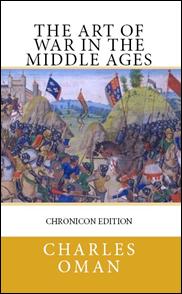
Charles
William Chadwick Oman, KBE (1860 1946) was a British military
historian of the early 20th century. His reconstructions of medieval battles
from the fragmentary and distorted accounts left by chroniclers were
pioneering. His style is an appealing mixture of astute analysis and dramatic
narrative. He was born in Muzaffarpur district, India, the son of a British
planter, and was educated at Oxford University. In 1881 he was elected to a
Prize Fellowship at All Souls College, where he would remain for the rest of
his career. He was elected the Chichele Professor of modern history at Oxford
in 1905, serving as President of the Royal Historical Society (1917 1921),
the Numismatic Society and the Royal Archaeological Institute.
Oman was a Conservative member of
Parliament for the University of Oxford constituency from 1919 to 1935, and
was knighted in 1920.
This Chronicon edition is the
first volume of a two-volume edition, first published in 1898. It is a
critical analysis of the military strategy and tactics employed by the
Romans, Byzantines, Franks, Goths, Lombards, Anglo-Saxons, Vikings, Normans,
Magyars, Arabs, Turks, and Crusaders during the early Medieval period from
the later days of the Roman Empire to the Crusade of St. Louis. It describes
the weapons and armor used by these various peoples, and it provides dramatic
accounts of many of the battles fought during this turbulent period, such as,
Adrianople, Hastings, Manzikert, Tiberias (Hattin), and others.
|
Charles
Francis Adams II (May 27, 1835 to May 20, 1915) was a member of the prominent
Adams family. He served as a colonel in the Union Army during the American
Civil War. After the war, he was a railroad regulator and executive,
president, successively, of the Union Pacific Railroad, the Massachusetts
Historical Society, and the American Historical Association. His writings and
addresses both on problems of railway management and on historical subjects
frequently gave rise to widespread controversy.
In this work, first published in
1886, Adams writes with impressive expertise and clarity on the origins of
and problems with the railroads in Europe and America. The section on origins
is devoted mostly to some of the more entertaining and naively charming
first-hand accounts of the opening ceremonies for, and early excursions on
the first primitive railroads in Britain, South Carolina and Massachusetts.
In the section on problems he describes the approaches taken by various
countries to construct, operate, and regulate their railroad systems,
especially in the United States where unbridled competition was the rule.
At the time he wrote this work,
American railroads were almost entirely unregulated and were engaged in
ruthlessly self-destructive warfare with each other at great cost to the
nation. He applies his considerable expertise to the problems associated with
railroad services, regulations, competition, monopolies, associations, and
responsibilities, and he offers well-considered opinions on how these
problems needed to be solved taking into consideration the peculiar character
of America and Americans.
Railroads, written
by a significant historian with considerable practical as well as academic
experience, is both an important and an enjoyable read for any student of
American history and business.
|
Because
of their many accomplishments, the ancient Phoenicians are often written
about, but comprehensive works about them are comparatively rare. This
history by George Rawlinson, first published in 1889, is one of the
exceptions. His vivid portrait shows them to be incredibly daring navigators;
intrepid merchants who brought the essentials and amenities of civilization
to western Asia, southern Europe, and northern Africa; courageous and
resourceful defenders of their great cities against the most powerful empires
of the ancient world; designers and builders of the first ships capable of
sailing the open ocean; inventors of the world s first practical alphabet;
skilled craftsmen whose services and products were sought after by foreign
kings and nations. Their merchants were honored and respected for their
honesty and the quality of their goods. They were developers of much of the
mining and metallurgical technology that made the Bronze Age possible.
Specific accomplishments of the
Phoenician league of independent city states which still resonate in our own
era, include the design and decoration of the Temple of Solomon, one of the
architectural wonders of the world. They were the first to circumnavigate
Africa, two thousand years before the Portuguese managed the feat. They
founded the great Carthaginian state that contended with Rome for domination
of the Mediterranean basin. They conducted the heroic defenses of Tyre
against the Assyrians, Persians and Alexander the Great, yet their pragmatic
approach to foreign relations enabled them to survive and prosper in spite of
the invasions by a series of overwhelmingly powerful and ruthless conquerors.
Their essential pragmatism was probably the reason their ancient culture and
religion (a pagan religion marred by alleged child sacrifice and temple
prostitution) were, in the end, quietly absorbed into those of Greece, Rome,
and, ultimately, Christianity without a serious struggle. Pragmatism may also
be the reason that they never created a great literature that would have
perpetuated their renown. For them, the alphabet was merely a practical tool
of commerce.
|
|
|
|
|
|
In 1921,
when this book was first published, the city of Butte, Montana had become the
richest and most notorious mining camp in the world. Planted amidst the
remote splendor of the Rocky Mountains on top of the greatest deposit of
metal wealth ever discovered, it required enormous infusions of capital and a
vast army of laborers to extract that wealth from nature s deep granite
vaults. According to the author, at least 52 nationalities were represented
in the workforce imported by the eastern capitalists to make it all possible,
and these miners and merchants brought with them many of their own diverse
traditions, creating a cultural amalgamation like no other. Butte, rich
beyond imagination, soon became a magnet for every kind of dreamer, striver,
builder, reformer, schemer, opportunist, exploiter, corruptor, prostitute,
thief, and charlatan known to mankind. It became a stage for triumph and
disaster where anything could happen, a city of dreams fulfilled and dreams
broken. The world had never seen anything like it.
The author, George Wesley
Davis, had experienced it all. He had come to Butte as a young man from
Iowaville, Iowa to deliver a herd of beef cattle and cases of whiskey to the
ravenous city. He stayed on to become a newspaper reporter and prominent
businessman with a deep affection for his adopted city, both for its virtues
and its faults. In these Sketches, he describes not the well-documented
stories of the ruthless mining companies, subservient courts, and corrupt
politics. Instead, he provides a first-hand account of day-to-day life in a
truly unique city at a time when the ephemeral nature of Butte s wealth was
just beginning to become apparent. He writes about miners, cowboys,
vigilantes, farmers, hack drivers, whores, swells, millionaires, merchants,
paupers, opium fiends, domestic architecture, the great influenza pandemic of
1918, and the imposition of Prohibition. At the end, he laments the exodus of
the old-money class, a circumstance that gave the first hint that all that
wealth was destined to go elsewhere and the people of Butte, who had created
it at great cost to their own well-being, would eventually be left with
almost nothing but a vast hole in the ground filled with toxic waste.
Though an educated,
well-traveled, and broad-minded businessman, Davis was certainly a product of
his times, as is readily evident from his writing style. It is a style worth
noting, however, as it gives us a deeper picture of the times in which he
lived.
|
Charles
Francis Adams II (May 27, 1835 to May 20, 1915) was a member of the prominent
Adams family. He served as a colonel in the Union Army during the American
Civil War. After the war, he was a railroad regulator and executive,
president, successively, of the Union Pacific Railroad, the Massachusetts
Historical Society, and the American Historical Association. His writings and
addresses both on problems of railway management and on historical subjects
frequently gave rise to widespread controversy,
In this work, first published in
1911, Adams writes with impressive clarity and fresh perspective a severe
critique of George Washington s military abilities as opposed to his
qualities of character that made him a great leader; the strategic aspects of
the American Revolution; and the need for American historians of that period
to refrain from sacrificing the truth to patriotic self-indulgence. He
describes the War of 1812 s battle of New Orleans from a British perspective.
Moving on to the Civil War, he
discusses the moral and constitutional rights of the States to secede from
the Union; the South s tragic self-delusion that led to war; the decisive
role of the Union s naval blockade of the South; the consequential
incompetence of Union general, Benjamin Butler; and the rules of war with
respect to Sherman s march to the sea. He delivers a thoughtful
dissertation on the nature of Robert E. Lee s treason, his actions at
Gettysburg, and the profound significance of his conduct at Appomattox. He
describes the diplomatic maneuvering during the Civil War by the United
States and the Confederacy for the purpose of influencing British and French
policies flavored with a lesson about the unreliability of eyewitness
accounts as an historical resource.
Studies, Military and Diplomatic, written
by a significant historian with considerable practical as well as academic
experience, is both an important and an enjoyable read for any student of
American history.
|
History
of the Indian Navy by Charles Rathbone Low: This is the first of four
volumes originally published in 1877 (two volumes) and covers the history of
the Indian Navy from 1613 to 1816 when it was called the Bombay Marine and
served as the naval arm of the British East India Company. It is, essentially,
a tale of high adventure at a time when the British and other European
countries had no distinct technological advantages over the Asian powers they
encountered as they sought to expand their wide-ranging mercantile empires.
It is filled with harrowing first-hand accounts of these adventures in
distant lands that, by their very nature, could never avoid being
romanticized by later generations.
The Bombay Marine was formed to
protect the East India Company s merchant ships from the pirates of the
Malabar coast and the Portuguese warships that sought to preserve Portugal s
lucrative monopoly in the Indian Ocean trade. Most of its little-known
battles were fought on a small-scale against the ships, boats, and
strongholds of Arab, Malay, and Indian pirates, and such English buccaneers
as Captains Kidd and Avery, in exotic locations, ranging across the southern
oceans from the Red Sea, to the Persian Gulf, the Arabian Sea, the Bay of
Bengal, the East Indies, and as far east as the China Sea. It soon, however,
became an instrument of empire and was involved in sea battles with and
against the naval forces of the Mogul emperors, the shahs of Persia, the
Maratha (Mahratta) Rajahs, and the ships of the Dutch and French colonial
empires.
The three subsequent volumes of
Charles Low s History of the Indian Navy will chronicle the transformation of
the East India Company s Bombay Marine to the British Empire s Indian Navy,
and its ultimate and much regretted disbandment in 1863.
|
|
|
|
|
|
This new
edition of the original work which was a type-written report prepared in 1959
by the Office of the Chief of Military History, Department of the
Army. It has been reformatted for easier reading, but no information has been
left out.
This original volume was intended
to be a reference source and an aid to research, for use by military
professionals and historians. It is concerned with the organization and
disposition of the United States Army ground forces that opposed the Japanese
during World War II. The area covered includes Alaska, the islands of the
central and south Pacific, Australia, New Guinea, New Zealand, the
Philippines, Okinawa, China, Burma, and India.
It tracks the movements of the
tactical units from the day of Pearl Harbor to the surrender of the Japanese
forces on August 15, 1945. It examines in precise detail the enormous
administrative and logistical effort required to support combat operations in
the Pacific Theater. It provides basic information on the following subjects:
activations; training, reorganizations; redesignations; locations of units;
locations of command posts; missions; operations; designations, formation and
dissolution of task forces; commanders; assignment of units; attachment of
units; and intraservice command relationships.
|
In 1016,
the ruthlessly ambitious, but obscure, knights of the Norman House of
Hauteville came to southern Italy and managed to create a kingdom of their
own. Under its first king, Roger II, the Kingdom of Sicily, which included
southern Italy, became the most cosmopolitan, tolerant, and enlightened state
in Medieval Europe, where Muslims, Christians, Greeks, Normans, Lombards,
Italians, Arabs, and Jews lived in relative harmony. By virtue of its
strategic location and powerful navy it was at the center of the
Mediterranean world. It was coveted by the Byzantine Empire, the Holy Roman
Empire, the Roman Catholic Church, and the Almohad and the Fatimid
Caliphates. Eventually, the Hauteville kings succumbed to the Hohenstauffen
emperors, where the author ends his history, even though the kingdom
continued on as a powerful and enlightened vassal state of the Holy Roman
Empire.
The author, Edmund Curtis,
1881 to 1943, was a professor of history at Trinity College in Dublin from
1914 to 1939, and an editor of Irish historical documents. His work, Roger of
Sicily, covers Sicily s Norman period from 1016 to 1154.
|
The
Secret Societies of all ages and countries by Charles Heckethorn: Originally
published in 1875, Heckethorn s book is a comprehensive account of the many
secret societies with hidden agendas and esoteric doctrines that have been in
existence since at least the time of the Egyptian Pharaohs up to the date of
its publication. He classifies secret societies as follows: 1.
Religious societies such as the Egyptian or Eleusinian Mysteries. 2. Military
societies like the Knights Templar. 3. Judiciary societies such as the German
Vehmgerichte. 4. Scientific societies like the Alchymists. 5. Civil societies
typified by the Freemasons, and 6. Political societies such as the Carbonari.
There are also accounts of the Cabala, Gnostics, Illuminati,
Druzes, Druids, Fenians, Rosicrucians, Communes, trade unions, and many
others, some well-known, others so obscure that their very existence is
doubtful.
His writing is full of 19th
century English prejudices but is, never-the-less, highly informative. It
also reveals much about the social turmoil that troubled western Europe
during the century in which he lived.
|
|
|
|
|
|
George
Payne Rainsford James (August 9, 1799 June 9, 1860), was an
English novelist and historical writer, the son of a physician in London. He
was for many years British Consul at various places in the United States and
on the Continent. He held the honorary office of British Historiographer
Royal during the last years of William IV s reign.
His The History of Chivalry was
published in 1857 and provides a detailed account of the precepts of medieval
chivalry, and the various orders, such as the Templars, Hospitallers and
Teutonic Knights, which came into existence during the Crusades.
|
Friedrich
Schiller s classic history of the savage war of religion that devastated
Germany and tore apart the Holy Roman Empire and the Catholic Church during
the years 1618 to 1648. It was the time of Gustavus Adolphus, the Hapsburg
Emperor Ferdinand II, Cardinal Richelieu, Albrecht von Wallenstein, terrible
battles, starvation, social collapse, and intolerable suffering.
Friederich Schiller (1759 to
1805) was a German poet, philosopher, historian, and playwright. In this
work, Schiller provides a perceptive description of how a religious war
became a political war which forever transformed the politics of Europe. The
English translator of this edition was the Reverend Alexander James William
Morrison (1806 to 1865).
|
This
volume contains the full texts of eight documents composed by the founding
fathers which established the United States of America in its present form.
Included are The
Articles of Association, The Declaration of Independence, The Articles of
Confederation, the Constitution with the amendments, and four
other documents of critical importance.
|
|
|
|
|
|
Sir
Charles William Chadwick Oman, KBE (1860 1946) was a British
military historian of the early 20th century. His reconstructions of medieval
battles from the fragmentary and distorted accounts left by chroniclers were
pioneering. His style is an appealing mixture of astute analysis and dramatic
narrative. He was born in Muzaffarpur district, India, the son of a British
planter, and was educated at Oxford University. In 1881 he was elected to a
Prize Fellowship at All Souls College, where he would remain for the rest of
his career. He was elected the Chichele Professor of modern history at Oxford
in 1905, serving as President of the Royal Historical Society (1917 1921),
the Numismatic Society and the Royal Archaeological Institute.
This work should not be confused
with his later, more detailed, two-volume work, A History of the Art of War
in the Middle Ages which is also available from Chronicon Books (see Index).
Oman was a Conservative member of
Parliament for the University of Oxford constituency from 1919 to 1935, and
was knighted in 1920.
This work, published in 1885, is
a perceptive study of the battle tactics that prevailed during the Middle
Ages in the later Roman empire, the Byzantine empire, the Swiss
confederation, Spain, England, France and Bohemia.
|
Claude
Reignier Conder, 1848 to 1910, was a British soldier, explorer and antiquarian.
Conder was educated at University College London and the Royal Military
Academy, Woolwich. He became a lieutenant in the Corps of Royal Engineers in
1870. He carried out survey work in Palestine in 1872 1874, latterly in
conjunction with Lt. Kitchener, later Lord Kitchener, whom he had met at
school, and was seconded to the Palestine Exploration Fund from 1875 to 1878
and again in 1881 and 1882, when he was promoted captain. He retired with the
rank of colonel in 1904.
The Latin Kingdom of Jerusalem is
a history of the Crusader kingdom from its foundation in 1099, during the
dramatic First Crusade, to its end in 1291. Conder describes its notable
characters, enemies, institutions, military establishment, economy, laws, and
its many campaigns and battles.
The object of this volume is,
however, not so much to relate the history of Crusades, as to present a
picture of the curious social conditions which resulted from the
establishment of a feudal society amid Oriental surroundings, and to trace
the growth of civilisation and prosperity during the two centuries of Latin
rule. The period is one of the most interesting in history, and the results
of Frank colonisation in Palestine were far-reaching and important.
|
Herbert
Albert Laurens Fisher, OM, FRS, PC (March 1865 to April 1940) was
an English historian, educator, and Liberal politician. He served as
President of the Board of Education in David Lloyd George s 1916 to 1922
coalition government. Fisher was a tutor in modern history at the University
of Oxford. In 1912, he was appointed (with others) as a member of the Royal
Commission on the Public Services in India. Between 1913 and 1917 he was
Vice-Chancellor of the University of Sheffield. In 1916 Fisher was elected
Member of Parliament for Sheffield Hallam.
In this first of two volumes,
originally published in 1898, Fisher describes the workings of the Holy Roman
Empire in Germany during the Medieval period, both in theory and in practice.
The concept of a universal empire was more powerful in Europe than the
actual state that was formed around it. Fisher explores the remarkable
survival of the Roman imperial idea after the fall of Rome in 476. He
discusses the tribes and tribal confederations that eventually coalesced into
a national state. He describes the workings of the German monarchy; the
legislative processes in Germany; the Imperial court relative to the laws of
inheritance; Imperial finances; and the status of the German nobility. He
offers analyses of how each of these factors contributed to the Empire s
inherent weakness and its ultimate failure.
|
|
|
|
|
|
|
|
|
|
|
|
Index of Available
Books
|
|
|
|
|